
What ASME B31.3 actually covers
ASME B31.3 is the process piping code, published by the American Society of Mechanical Engineers as one section of the larger B31 family of pressure piping codes. The full title is ASME B31.3: Process Piping, and it is the dominant standard for piping in industrial process facilities. For engineering teams new to the code, ASME B31.3 explained in plain terms is straightforward: it sets the technical and quality rules for any piping system that handles process fluids in an industrial setting.
The code covers the design, materials, fabrication, assembly, examination, inspection, and testing of pressure piping systems used in process service. It applies to piping that handles liquids, gases, slurries, and high-purity media across a wide range of pressures, temperatures, and fluid service severities.
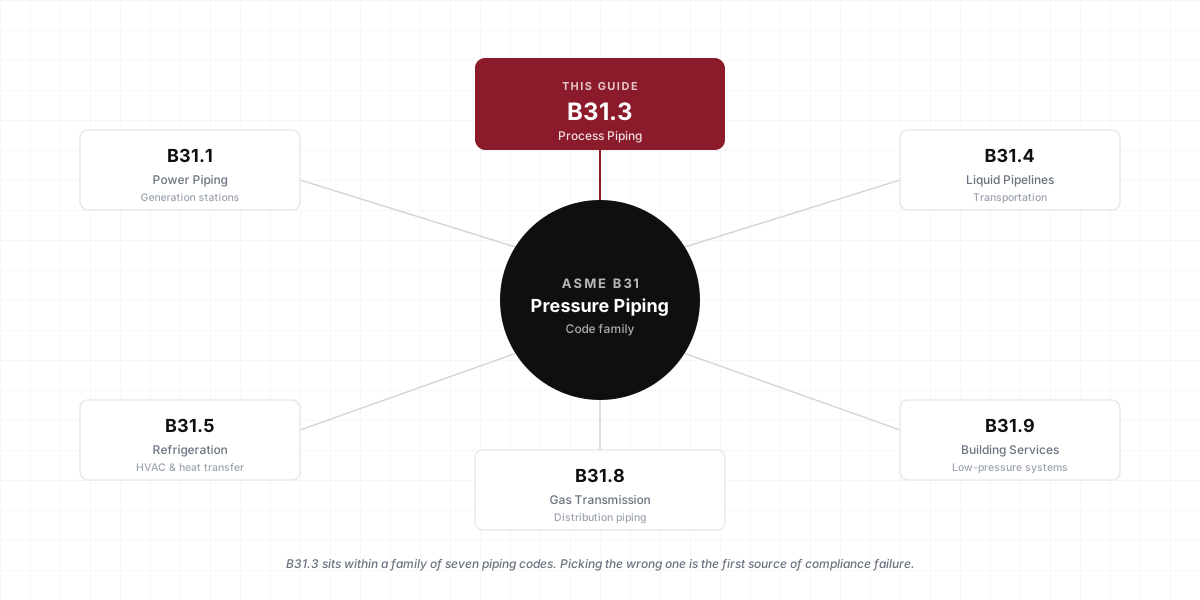
It is important to understand that B31.3 is one of seven codes within the ASME piping standards family. The others cover power piping, fuel gas piping, liquid pipelines, refrigeration piping, gas transmission and distribution piping, and building services piping. Each one is technically a stand-alone code with its own requirements. Confusing which one applies to a given system is the first place compliance fails, often before any engineering work has been done.
Why B31.3 compliance matters
Before going deeper into scope, categories, and requirements, it is worth naming what is actually at stake when B31.3 compliance fails. The risk is not abstract. It shows up in six places that operating companies, EPC contractors, and asset owners track every project, every cycle.
Safety incidents
Loss of containment, exposure events, and worst-case process safety incidents.
Delayed commissioning
Schedule slips that push first oil, first product, or first revenue weeks or months later.
Failed audits
Third-party, regulatory, or owner audits that flag findings the project cannot defend.
Rework costs
Re-fabrication, re-inspection, and re-testing when documentation gaps surface after the fact.
Insurance exposure
Coverage gaps and premium increases when compliance evidence cannot be produced.
Asset integrity risk
Long-term reliability and remaining-life uncertainty inherited by the operating company.
Each of these has been the subject of post-incident investigations, owner-led project reviews, and inspector findings on real industrial projects. The common thread is rarely a defective piping system. It is a documentation trail that does not survive scrutiny when something goes wrong.
Where ASME B31.3 applies, and where it doesn't
The applicability question matters because mixed facilities, especially refineries, petrochemical sites, and pharmaceutical plants, often contain piping that falls under more than one B31 code. Process piping carrying feedstock through a reactor is B31.3. Steam piping powering the same plant from a utility boiler is B31.1. Getting that distinction right is the difference between a compliant project and a discovery in audit.
- ✕Power generation piping (B31.1)
- ✕Building service piping (B31.9)
- ✕Liquid transportation pipelines (B31.4)
- ✕Gas transmission pipelines (B31.8)
- ✕Refrigeration piping (B31.5)
- ✕Plumbing, sewage, and fire protection systems
- ✓Refineries and petrochemical plants
- ✓Chemical and pharmaceutical facilities
- ✓Semiconductor and high-purity gas systems
- ✓Cryogenic and air separation plants
- ✓Food, beverage, and biotech processing
- ✓Offshore and onshore production facilities
The code itself defines exclusions in Section 300. Owners and designers should confirm applicability at the project basis stage and document the decision in the design basis memorandum. That documented decision is what an inspector will trace to during an audit.
The fluid service categories
ASME B31.3 does not treat all piping equally. Compliance obligations scale with the severity of the service the piping handles. The code defines five fluid service categories, each carrying different design, material, fabrication, and inspection requirements.
Category D
Non-flammable, non-toxic fluids at limited pressure and temperature. Lowest design rigor and inspection burden. Used for utility services such as instrument air, low-pressure cooling water, and non-hazardous drainage.
Normal Fluid Service
The default category. Applies to most process piping in standard refining, petrochemical, and chemical service. Baseline requirements for design, materials, examination, and testing.
Category M
Highly toxic or hazardous fluids where a single exposure could cause serious irreversible harm. Significantly stricter design, examination, and testing requirements. Joint efficiency factors and inspection coverage scale up.
High Pressure Fluid Service
Owner-designated piping operating above the pressure-temperature ratings of ASME B16.5 Class 2500. Chapter IX of B31.3 applies, with its own design rules and examination obligations.
High Purity Fluid Service
Owner-designated piping where contamination is the controlling concern, common in pharmaceutical, biotech, and semiconductor service. Chapter X applies, with strict requirements on surface finish, joint design, and traceability.
The category is determined by the owner during design basis development. That determination drives every downstream compliance requirement: which materials are acceptable, which welding procedures are permitted, what percentage of welds require radiography, and what documentation must be retained. Mis-categorizing a service is one of the most expensive errors a project can make, because every requirement downstream of the categorization is then either over-engineered or non-compliant.
Core compliance requirements
The process piping code requirements in B31.3 rest on four pillars. Each pillar generates its own deliverables, its own documentation, and its own examination obligations. A project that gets three right and one wrong will still fail the audit.
Design
Pressure design of components, flexibility and stress analysis, support design, and selection of pressure-temperature ratings. Driven by Chapters II and III. This is the layer where piping design standards meet process reality. Documented in line lists, stress reports, and the design basis memorandum.
Materials
Selection of acceptable materials per Chapter III and Appendix A, which together form the core of B31.3 piping material standards. Includes pressure-temperature limits, low-temperature toughness requirements, and restrictions for specific fluid services. Documented in material test reports and material traceability records.
Fabrication
Welding, brazing, bending, forming, and heat treatment requirements per Chapter V, the part of the code most commonly cross-referenced as piping fabrication standards. Includes welding procedure qualification, welder qualification, and post-weld heat treatment where applicable. Documented in WPS, PQR, welder qualification records, and weld maps.
Examination & Testing
Visual, radiographic, ultrasonic, magnetic particle, and liquid penetrant examination per Chapter VI. Hydrostatic or pneumatic pressure testing per Chapter VI as well. Documented in NDE reports, hydrotest records, and inspector certifications.
None of these pillars stands alone. A perfect design with under-documented materials still fails the audit. Fully traceable materials with under-examined welds still fails the audit. The compliance story is the integration of all four, and the documentation trail is what makes that integration visible.
Inspection and examination obligations
Examination requirements in B31.3 scale with fluid service category and joint type. The minimums for Normal fluid service are the baseline most projects work from, with additional requirements layered on top based on category and owner specification. Engineering teams should treat this section as the starting point for any project-specific piping inspection checklist.
Required minimum examinations
For Normal fluid service, the code requires at minimum:
Visual examination
Of all welds, both in fabrication and during installation, by qualified personnel.
Random radiographic examination
At least 5% of girth and miter groove welds for piping in Normal service. The selected welds must be representative of each welder's work and each material.
In-process examination
Of fitup, joint preparation, and welding parameters.
Hardness testing
Of welds in post-weld heat treated piping, to verify PWHT effectiveness.
Hydrostatic or pneumatic pressure testing
Of the completed piping system before being placed in service.
Expanded examinations for higher categories
Category M piping requires increased examination coverage including 100% radiography of certain joints. High Pressure piping under Chapter IX has its own dedicated examination requirements that exceed the baseline. High Purity service under Chapter X focuses examination on cleanliness and surface finish in addition to weld integrity.
Owners frequently specify examination requirements beyond the code minimum in the project specification. When the project spec is more stringent than the code, the project spec governs. This is one of the most common areas where compliance teams misread their obligations: B31.3 sets the floor, not the ceiling.
Documentation and traceability
Compliance with ASME B31.3 is not just about doing the work correctly. It is about being able to prove the work was done correctly, often years after the piping is in service. The documentation trail is the audit-defensibility layer of the entire code.
Design basis memorandum
Code edition applied, fluid service categorization, design pressure and temperature ranges, applicable owner specifications.
Material test reports (MTRs)
For every pressure-containing component, traceable to specific heat numbers and piping line numbers.
Welding procedure specifications (WPS) and procedure qualification records (PQR)
For every welding procedure used on the project.
Welder performance qualification records
For every welder who worked on the project, with documented qualification dates and ranges.
Weld maps
Identifying every joint by location, welder ID, procedure used, examination performed, and result.
Non-destructive examination records
Radiographic films or digital records, ultrasonic reports, MT and PT records, all signed by qualified examiners.
Heat treatment records
Time, temperature, and equipment calibration, where PWHT was required.
Hydrostatic or pneumatic test records
Pressure, hold time, witness signatures, and any leak-test results.
Field change and deviation records
Any deviation from the approved design, including authorizations and re-qualification where required.
Most compliance failures discovered during audit do not stem from a piping defect. They stem from gaps in this documentation trail. A weld may have been correctly examined and the result correctly recorded, but if the weld map cannot identify which welder performed the joint or which procedure was used, the documentation is incomplete and the compliance is unverifiable.
Where ASME B31.3 compliance typically fails
After thousands of inspections, the failure modes are predictable. They are not failures of the code or failures of competent engineers. They are failures of process, handoff, and traceability at points where projects are under schedule pressure.
Spec breaks at material interfaces
The piping class changes at a flange or transition, but the documentation does not track the change correctly. Downstream inspectors find a Class 600 valve installed where the line list says Class 300, or vice versa, with no engineering record explaining the substitution.
Missed or incomplete post-weld heat treatment
PWHT is required for certain materials, thicknesses, and service conditions. When the welding sequence is rushed, joints can be installed before PWHT is performed, or hardness verification is missed. The weld may be sound. The compliance evidence is not.
Examination coverage shortfalls
The 5% radiographic minimum for Normal fluid service must be representative. When inspections are concentrated on convenient joints rather than distributed across welders and materials, the project meets the percentage but fails the intent. Auditors flag this routinely.
Unauthorized material substitutions
A fabricator substitutes a material on short notice because the specified material is unavailable. The substitution may be technically acceptable, but it is implemented without engineering review and without an updated MTR linked to the line. The audit trail breaks at the substitution.
Incomplete hydrotest documentation
The system was tested, the pressure was held, no leaks were observed. But the test record is missing a witness signature, the gauge calibration record is expired, or the test boundaries are not clearly identified on the test package. The test happened. The compliance evidence does not survive.
Undocumented field changes
Field engineering issues a change to address a constructability issue. The change is implemented and the system works. The MOC trail, the redline drawing, and the link back to the design basis are never completed. Months later, the as-built does not match the operating reality.
The pattern is consistent. The work itself is usually correct. The trail of evidence is what fails, and the trail is what an auditor or operating company actually has access to years after the project closes.
Managing B31.3 compliance across the project lifecycle
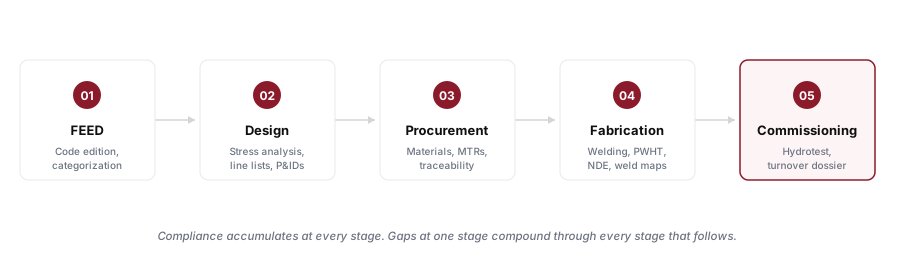
Compliance is not a single inspection at the end of construction. It is a discipline that has to be embedded at every project stage, from FEED through commissioning. Each stage has its own obligations, and the documentation trail accumulates across all of them.
FEED
The design basis is locked. Code edition, fluid service categorization, applicable owner specifications, and project addenda are documented. Mistakes here flow downstream and become expensive to reverse.
Design
Line lists are issued, stress analyses are completed, and pressure-temperature ratings are confirmed. Process piping design at this stage is governed by the line list, the design basis, and the applicable owner specifications. Every design decision should reference the relevant B31.3 clause and any owner specification that modifies it.
Procurement
Materials are ordered against the line list. MTRs are received, reviewed, and filed against specific lines. Material substitutions during this stage are common, and each one requires engineering authorization to remain compliant.
Fabrication
Welding procedures are qualified, welders are qualified, welds are made and examined, and PWHT is performed where required. This is the stage that generates the most documentation, and it is the stage where the most documentation goes missing.
Commissioning
Hydrotesting is performed and the turnover dossier is assembled. The dossier is the audit-ready summary of every compliance decision made during the project, and the quality of the dossier is what an operating company inherits.
Across this lifecycle, modern compliance teams are starting to use AI-assisted verification platforms to handle clause-level checks across thousands of deliverables. The strongest use cases are documentation completeness, examination coverage tracking, and consistency between design intent and as-installed reality. None of these replace engineering judgment. They reduce the lookup and reconciliation burden that historically caused the audit-trail gaps in the first place.
ASME B31.3 is a deeply considered code. The work of complying with it is technical, but the work of proving compliance is operational. The organizations that handle piping safety compliance well are the ones that treat documentation as a deliverable, not a paperwork burden, from the first day of FEED through the last day of construction.
FAQs